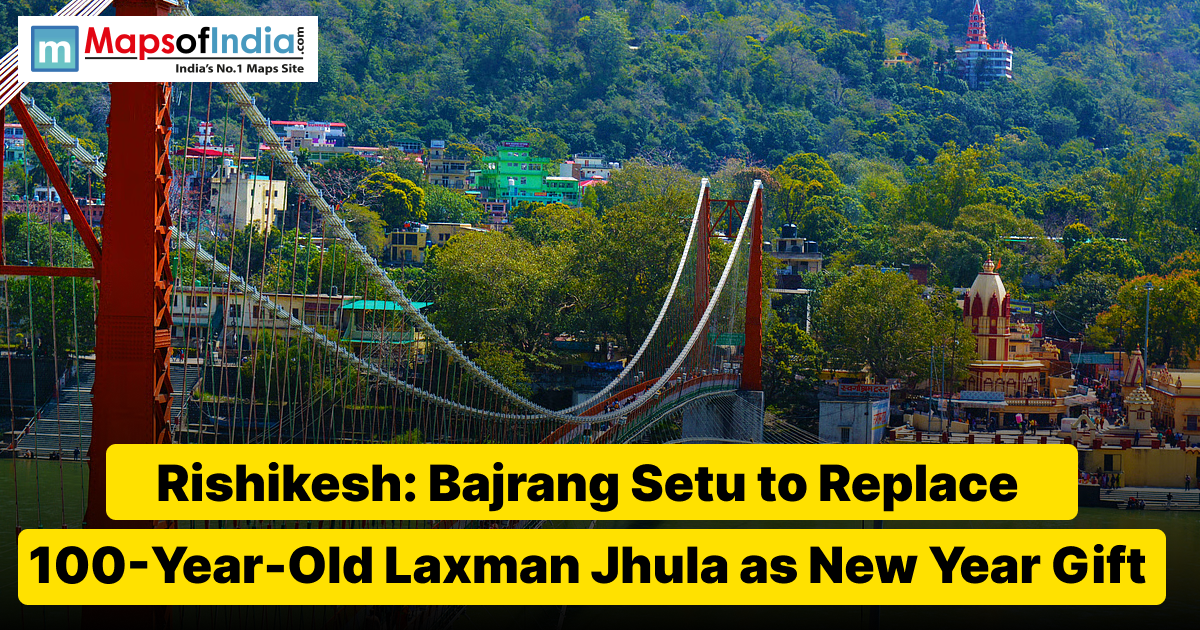
Rishikesh will also see a significant improvement in terms of infrastructure as the upcoming project, the opening of Bajrang Setu, a modern suspension bridge, will be used to replace the popular Laxman Jhula that has served the city for over the last one hundred years. The new bridge can be seen to be a New Year present to the people, pilgrims, and tourists, who will have safer and better connectivity across the river Ganga.
Laxman Jhula, the historic structure built in 1929, has always been an indicator of the spiritual and cultural significance of Rishikesh. Nevertheless, in recent years, the bridge has been restricted to the movement of people because of structural ageing and safety issues. The reasons given by the authorities to limit access were increasing foot traffic, a high number of tourists, and deteriorating infrastructure, which necessitate the adoption of a new, modernized version.
Bajrang Setu is an advanced suspension bridge that has been constructed keeping in mind the state of engineering and technology in security measures. According to the officials, the new bridge will not only reinstate the connectivity between important regions of Rishikesh, but also will immensely improve pedestrian security. It has a glass deck walkway, which is among its best attractions, enabling visitors to see the Ganga flowing below to create an exclusive experience for tourists.
The bridge is 132 metres long and was built at an approximate cost of 68 crore. It is fitted with the latest lighting systems, CCTV cameras and sturdier structural elements to accommodate high volumes of people, mainly during the peak pilgrimage and tourism seasons. People in power think that the project will assist in reducing congestion and facilitating an easier flow within the city.
They gave it the name of a New Year gift, and officials said that Bajrang Setu is nearing completion and will be made available to the people very soon, when the new year is about to start, and this is also the high season of tourists. It is likely that the bridge will become a major catalyst in enhancing tourism, besides making access safer to both locals and visitors.
Although Bajrang Setu will replace the main crossing, the old Laxman Jhula will still be a memory as a heritage site. It is no longer used daily, but it still continues to be an important icon of the history and spiritual heritage of Rishikesh.
Rishikesh gets a new dimension with Bajrang Setu that gives a balance between the modern infrastructure and cultural continuity. The project is an expression of the city in its move to modernize the critical facilities without compromising its position as a global spiritual and tourism destination.