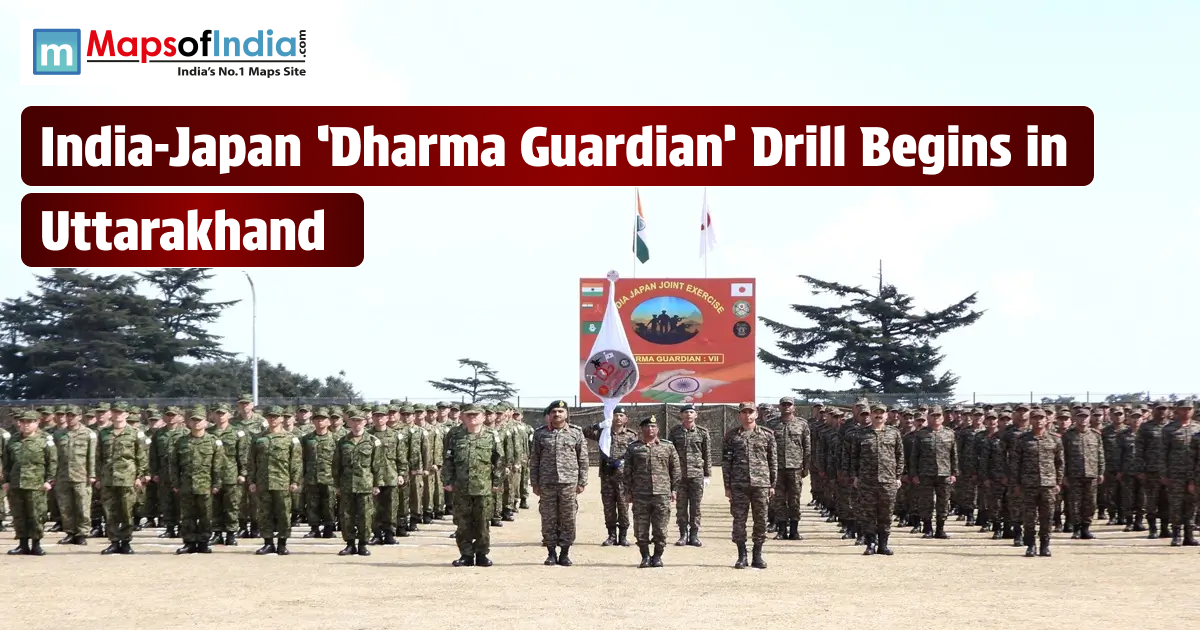
India and Japan are also enhancing their military cooperation through the joint military drill of Dharma Guardian, which is going on in the mountainous state of Uttarakhand. The practice unites the Indian Army with the Japan Ground Self-Defence Force (JGSDF), which is engaging in a set of combat exercises and operational training to enhance coordination and operational preparedness.
The exercise is a joint project of a permanent defence partnership between the two nations, and it is held every year. It swings between India and Japan, as the strategic ties and common security interests of the two countries have increased. The present version is being hosted in Chaubattia, close to Ranikhet in Uttarakhand, a region with hilly terrain, which offers the best conditions to train in mountain warfare.
Each country is participating in the exercise with approximately 120 soldiers. The Indian party is represented by the forces of the Ladakh Scouts, a regiment that is specialized in warfare in high altitude and mountains. The Japanese personnel of the 32 nd Infantry Regiment of the Japan Ground Self-Defence Force represent the Japanese side of the conflict.
In the exercise, there are troops of both nations engaged in different training activities that replicate real battle situations. These are training on temporary operating bases, intelligence and surveillance operations, vehicle roadblocks and training on cordon and search operations in semi-urban settings. The soldiers are also undertaking the drills in the area of counter-terrorism operations, which need the exact coordination and quick reaction.
Enhancement of interoperability between the armed forces of India and Japan is one of the main goals of Exercise Dharma Guardian. The concept of interoperability is the competence of the two military to collaborate effectively during joint operations, be it in peacekeeping operations, disaster response operations, or operations against security threats. Through the training, the soldiers get to know each other in terms of tactics, communication systems and how operations are done.
The drill also enables the two parties to share knowledge and experience in the contemporary methods of war. It gives the troops a chance to comprehend each other, trust and enhance professional relations.
Defence officials are of the view that these joint exercises are significant in ensuring stability and security within the Indo-Pacific region. The relationship between India and Japan has been growing in their cooperation in the fields of defence and strategy over the past several years due to the presence of common issues in the sphere of the security of the region.
In the article Exercise Dharma Guardian, it is pointed out that the two countries are increasingly becoming partners, and show their resolve to keep the peace, stability and security by enhancing the military cooperation.