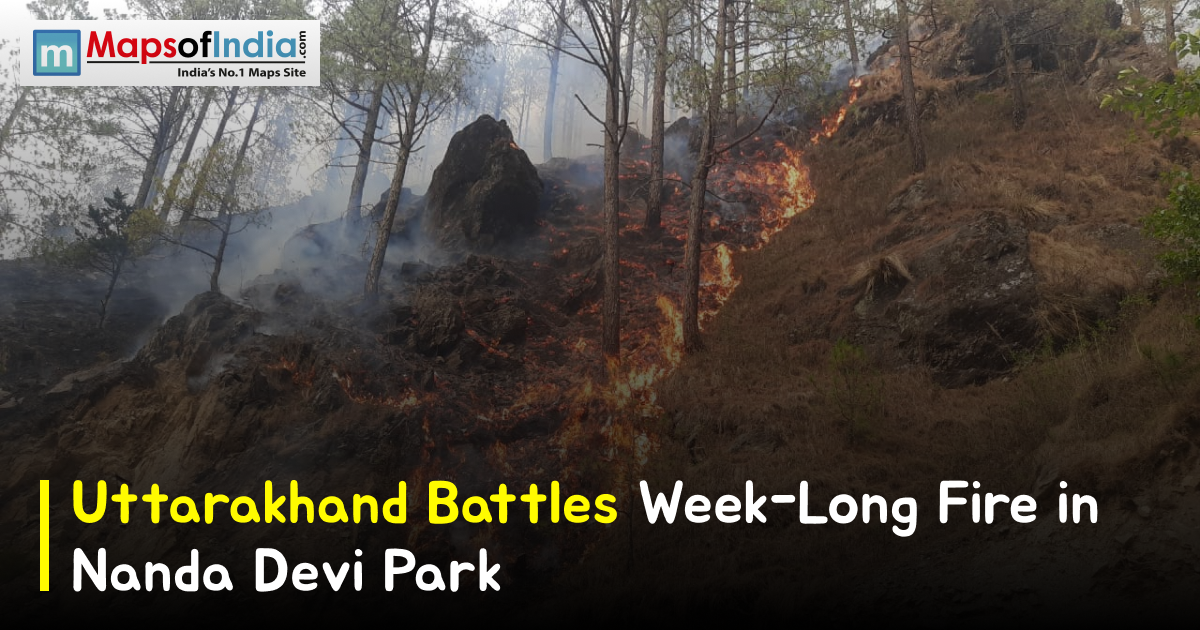
The forest fire in the isolated and biodiversity-rich Nanda Devi National Park in the remote Chamoli district of Uttarakhand has become one of the biggest predicaments to the forest department and the disaster response system in the state because it has lasted for seven days in a row. The fire, which has erupted in the high altitude forests in the Nanda Devi Biosphere Reserve, has been very hard to contain, as it is rugged with poor road accessibility and dry weather conditions.
Fire officials indicated that the fire is in steep terrain with thick forests, which are inaccessible to on-ground firefighters to a considerable extent. The park is a UNESCO World Heritage site in the upper Himalayan region and is characterized by a delicate alpine ecosystem, rare plants and wildlife. The presence of thick leaf litter, dry grass and woody debris on the forest floor has served as a fuel source, and the fires have propagated over the slopes and valleys.
The Uttarakhand administration has requested aerial support in order to aid firefighting operations. The Indian Air Force has posted a Mi-17 V5 helicopter at Joshimath to do air reconnaissance and possible water-dropping operations. Hotspots are also being tracked by the use of drones, and the fire is being tracked in areas that cannot be reached safely on foot.
The teams of the forest department, as well as disaster response teams, have been trying to establish fire lines and put out fires in accessible areas. But governmental authorities complain that the high winds at elevated altitudes and the lack of recent snow or rain have hampered the containment operations. The dryness in winter has caused vegetation to become unusually combustible, and hence more prone to flare-ups even in those areas that were previously placed under control.
The environmental professionals have raised a concern regarding the possible effect of the long-term fire on the biodiversity of the region. A number of endangered species and alpine-specific plants are found in the Nanda Devi Biosphere Reserve, and long-lasting contact with fire may cause loss of habitats, soil erosion, and irreversible ecological disturbance.
The government has indicated that the large tourist and pilgrimage areas in the area, such as the Valley of Flowers and Hemkund Sahib, are safe at the moment, but that they are being closely monitored. The local communities have also been advised that they should be on high alert and report any suspicious new signs of smoke or flames to the nearest forest offices.
The state government has also promised that it is working towards bringing the situation under control by ensuring that all the required resources are being marshalled. According to the officials, fires will be 24/7, but it is necessary to pay more attention to the fact that the fire should not spread to other areas of the reserve that are more sensitive.
With climate variability and changing weather patterns causing a rise in frequency of forest fires in the Himalayan region, the present occurrence has once again led to the realization that stronger early-warning mechanisms, improved infrastructure and long-term forest management plans are necessary to rescue one of the most valuable ecological treasures of India.