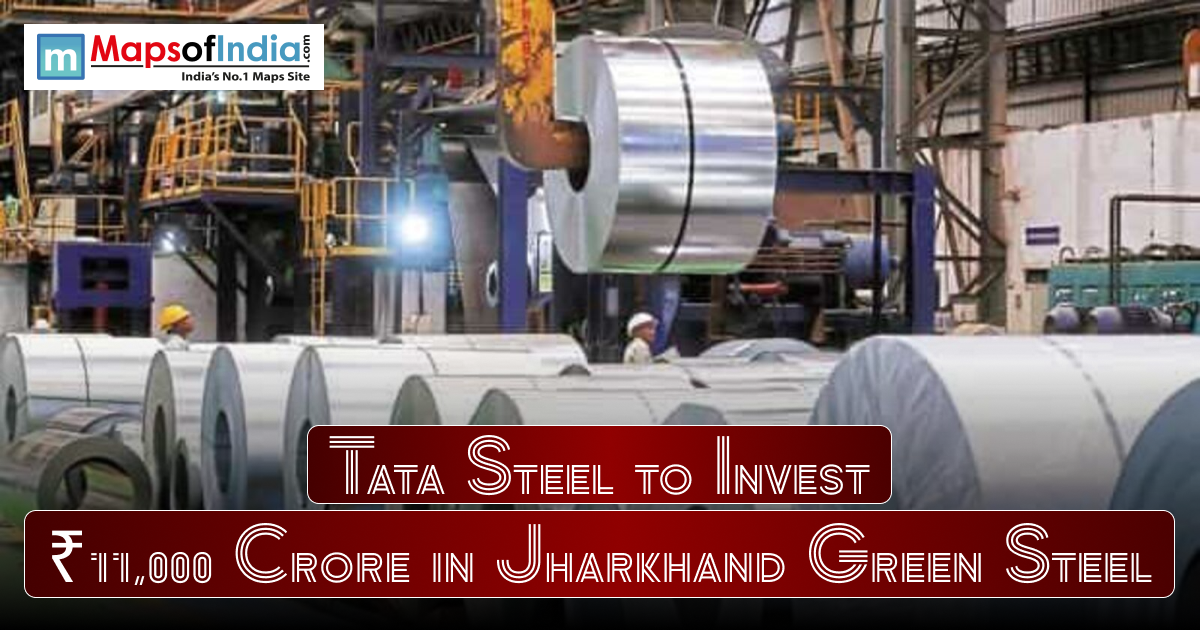
Tata Steel has made a big step in the direction of sustainable industrialization by announcing a massive ₹11,000 crore investment move in Jharkhand to establish green steel technologies. The announcement was made at the World Economic Forum (WEF) Annual Meeting in Davos, where the formalization of the project occurred with a cooperation agreement signed between Tata Steel and the Jharkhand government.
This high-scale investment is part of Tata Steel, ensuring low-carbon and environmentally friendly steel production, otherwise known as green steel. The project will entail a number of advanced programs, such as launching the Hirsana Easy and Melt Technology, which is a contemporary steel-making procedure that will minimize carbon emissions. The company will also hold its production of Tinplate and invest in a Combi mill Production and this will be a guarantee of a cleaner and more efficient production.
Of the 11,000 crore, 7,000 crore will be used in Hirsana Easy and Melt Technology, 2,600 crore in the expansion of Tinplate and 1,500 crore in Combi Mill. Tata Steel is also partnering with foreign companies in Germany and the Netherlands to introduce superior technologies that reduce the harm to the environment and enhance production efficiency.
The investment was welcomed by Jharkhand Chief Minister Hemant Soren, who was spearheading the state delegation at Davos in a move that would have resulted in sustainable industrialization in the state. This venture with Tata Steel, as Soren said, is not only a major economic stimulus, but a step forward for Jharkhand to green and sustainable industries.
Green steel is viewed as a game-changer for the steel industry across the world. Unlike the traditional steelmaking process that requires coal to a large extent and emits a huge volume of carbon dioxide, the green steel uses new technologies, such as direct reduced iron (DRI) with green hydrogen and electric arc furnace using renewable energy. Such methods will reduce emissions greatly and fit the agenda of carbonizing the world.
The investment also enhances the presence of India in the global steel market. As the world continues to agree on carbon emission regulations, more steel manufactured in a low-carbon process is bound to gain competitive advantages in the European and North American markets.
This is an 11,000 crore investment by Tata Steel, which marks a significant step in the green industrialization of India. It shows how there is an increasing attention towards sustainability despite the need to see economic growth, creation of jobs and technological development in the steel industry in Jharkhand.