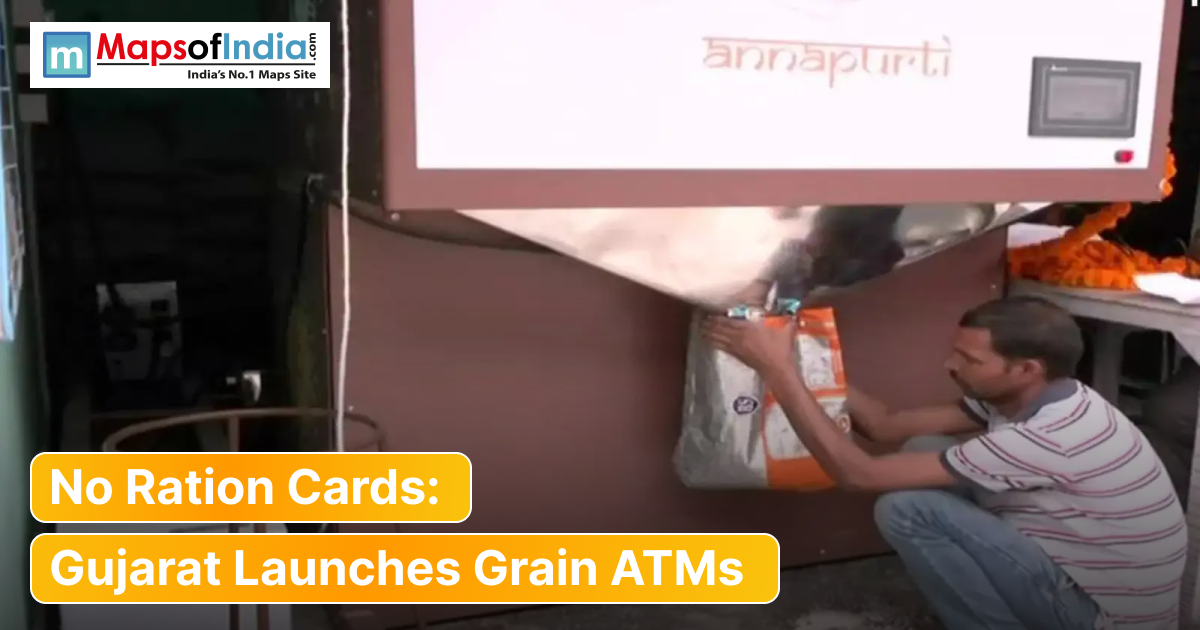
The government of Gujarat will start issuing subsidized food grains in ATM-like machines rather than the usual ration cards starting February 15 in a historic reform of modernization of the Public Distribution System (PDS). The program, which is defined as a historic shift in the system, is likely to help ease the transparency and minimize leakages as well as the delivery of food grains to the beneficiaries.
This means that under the new model, the eligible beneficiaries will retrieve their quota of food grains using digital authentication at the specially mounted grain ATMs in select fair price shops. Users will be issued a digital coupon/QR code on their registered mobile number instead of issuing a physical ration card. The code can be swiped in the machine, and the quantity of grains allocated will be automatically dispensed.
The initial stage of the implementation will start in sections of Ahmedabad, such as the Sabarmati region. Provided that the pilot is successful, the system is likely to be implemented statewide on a gradual scale. The officials indicated that the reform is in line with the overall digitization and improved service delivery mechanisms by the government.
The government asserts that the grain ATM would reduce such grievances that were being experienced by the current ration distribution paradigm, like scale under-weighting, manualistic mistakes, and time wastage. The automated machines will assist in the measurement and dispensing of accurate amounts, and thus will minimize the possibilities of malpractice. The digital tracking in real-time will also allow tracking the stock movement and beneficiary records much better.
The relocation is in connection with the attempt of Gujarat to enhance food security, as well as to ensure that the subsidies are provided to the target beneficiaries without corruption. The government plans to achieve a more transparent and responsible supply chain by substituting manual registers and paper-based audit with digital authentication.
The authorities have explained that the move will be done over time so that the beneficiaries, especially those in the rural section, will have an easy time adjusting to the new system. Counselling activities and awareness creation will be given at fair price stores in the first phase.
The reform is timely as a number of states are considering technology-driven solutions to update the welfare schemes. Provided that it succeeds, the example of Gujarat grain ATM can become a prototype to be followed by other states that want to computerize their PDS networks.
The launch of Gujarat on February 15 is a big step toward changing the distribution of essential commodities, and this is something that has signalled a new phase in the food security system of the state.