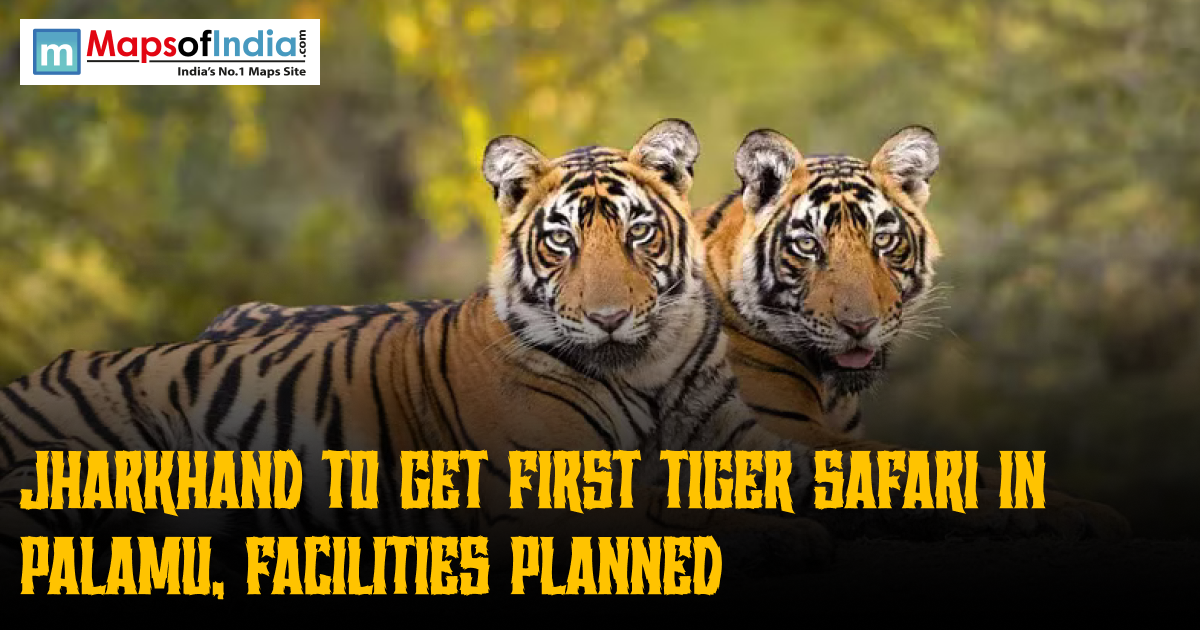
Jharkhand will have the first tiger safari in the state, and the state government has been completing the plans to construct the project in the Palamu area, near the Palamu Tiger Reserve (PTR). The program is being regarded as a significant measure in enhancing wildlife tourism and enhancing conservation and animal welfare systems in the state.
The officials of the Forest, Environment and Climate Change Department added that the tiger safari will be constructed outside of the core and buffer areas of the Palamu Tiger Reserve so that the natural habitat of wild tigers could be left undisturbed. A master plan is being developed in detail, and the architectural as well as wildlife planning professionals are being consulted in order to develop the facility in accordance with the national conservation norms.
The proposed safari will cover a big space and will accommodate rescued, orphaned, wounded, or conflict-prone tigers, which cannot be released to the wild. The project will be guided by the instructions that are put down by the Central Zoo Authority (CZA), and the development will focus on the welfare of animals and ecological balance, being at the centre of the project.
According to the initial designs, the master plan will consist of a set of contemporary facilities. These consist of large natural enclosures, quarantine areas, a state-of-the-art veterinary hospital with treatment rooms, operating units, a post-mortem centre, and neonatal services to animals. Surveillance systems and monitoring towers will also be provided to provide safety and 24/7 monitoring of the animals.
The safari will also have a well-structured entrance complex that includes ticket counters, parking, an information centre, and other basic facilities like cafeterias and restrooms for the visitors. Environmentally friendly electric safari cars will be used to drive tourists around the specific routes with a minimum level of noise and environmental pollution. The project is also supposed to include nature trails, bird enclosures and interpretation centres in order to encourage environmental education and awareness.
The master plan on infrastructure development involves the internal road system, water supply system, solar-powered electricity, waste management, and sewage treatment plant. Visitor and service routes will be developed separately to allow for seamless operations and safety.
Tourists feel that the tiger safari will boost eco-tourism in Jharkhand to supplement other local destinations like Betla National Park and Netarhat. The project will also create employment opportunities, which will be based in the localities and therefore will benefit communities in and around Palamu.
Upon approval, the project will be implemented in phases as the government tries to have a balance on conservation, tourism growth and sustainable development.