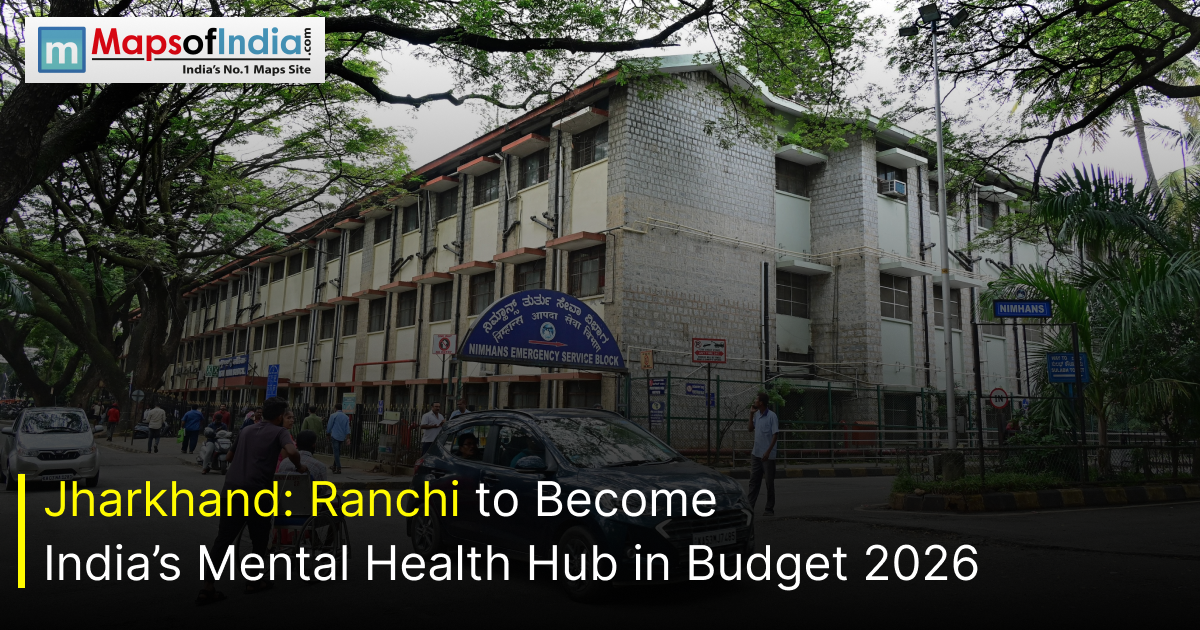
Ranchi will become one of the focal points of the mental healthcare system in India after a significant declaration in the Union Budget 2026, according to which the emphasis will be placed on building mental health nationwide once again. Finance minister Nirmala Sitharam announced that they will build a second National Institute of Mental Health and Neuro Sciences (NIMHANS 2.0) in northern India, as well as major upgrades to the existing institutions in Ranchi and Tezpur.
The relocation is expected to deal with historical imbalances in access to high-level mental health services, research centres, and professional training in the region. Up to this point, the NIMHANS based in Bengaluru is the only national-level mental health and neuroscience institute in the country where patients of India are treated. This new initiative is likely to not only ease the congestion in the facilities in the south but also make specialized care more accessible to the populations in the northern and eastern parts.
The plan will upgrade the Central Institute of Psychiatry (CIP), one of the oldest mental health facilities in the Asian region, which is located in Ranchi. The expansion will involve the increased infrastructure, the increased ability to conduct research and the increased ability to train mental health professionals. This will assist in making Ranchi one of the major referral and treatment centres of complicated psychiatric and neurological cases in Jharkhand and other surrounding states, according to officials.
The news is timely in a period where mental health issues are of national concern, and there are increasing incidences of stress, anxiety, depression and substance use disorder cases being reported in both urban and rural settings. The increased funding of the mental health systems of the populace, especially in the underprivileged areas, has long been demanded by experts.
Under budget highlights, the healthcare allocation is above the 1 lakh crore threshold, the first time in history, which is an indicator that there are overall changes in the weakening of population health delivery. The emphasis has been put on mental health as one of the areas of priority in the framework, in addition to efforts to establish better emergency services and affordable, necessary treatment.
Although the site of the new NIMHANS 2.0 campus in North India has not been decided yet, the government has assured that it will start working out the planning and alignment with the state authorities in the next few months. The proposed institute will provide a high level of clinical care, carry out research on the national level, and educate the future generations of psychiatrists, psychologists, and neuroscientists.
In the case of Ranchi, the developments are a major move towards being a national mental healthcare and research centre. The officials and the medical personnel in the area have received the move well, hopeful that it will translate to improved patient care, more health sector employment opportunities, and improved academic partnerships.
When the implementation commences, the stakeholders will be keenly focused on how these plans translate into on-ground facilities and services and will be defining the future of mental healthcare access in the North and East India.