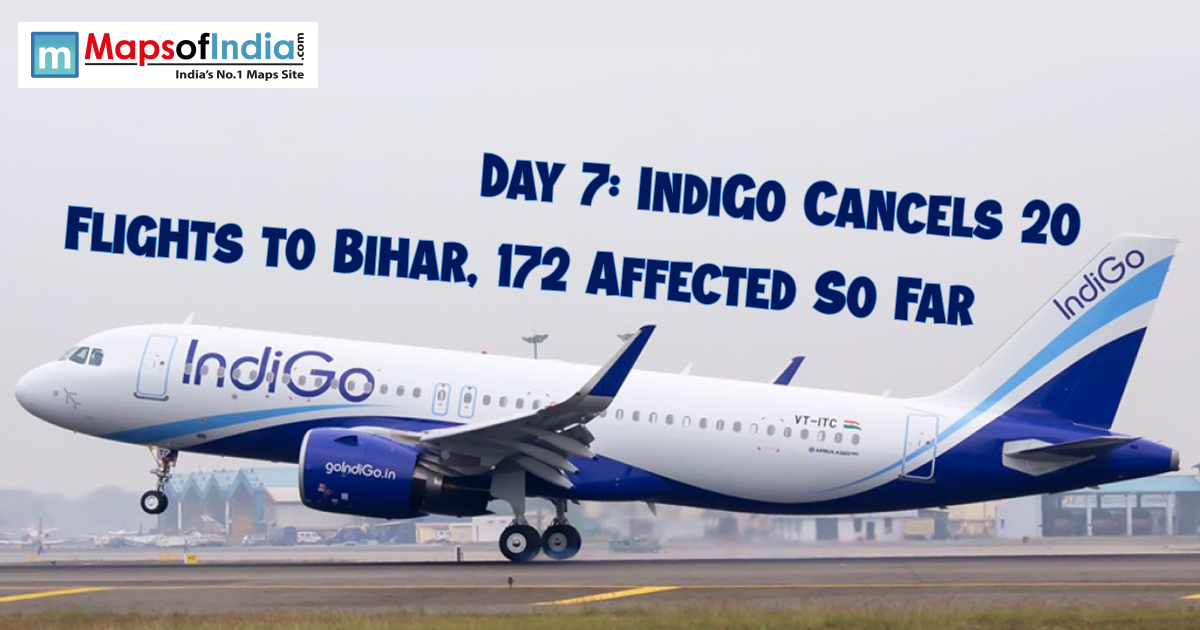
The current IndiGo flight crisis has continued interfering with air travel in Bihar, where, on the seventh day of operational interference, 20 flights to the state were cancelled. Up to now, 172 flights to Bihar airports have already been hit, and thousands of passengers are either stuck in the air or suffering serious transport crunches.
The cancellations have affected some of the major airports in the state, such as Patna, Gaya, Darbhanga, and Purnea. Business travellers, personal and leisure travellers have been forced either to fight over alternative flights or to think of alternative ways of transportation. Numerous last-minute alterations to their travelling plans were reported, and this caused a lot of inconvenience and stress.
The underlying cause of the disturbance is the internal operational problems of IndiGo, such as the crew scheduling problems, technical restrictions, and adherence to new aviation rules. Such problems have compelled the company to delay various flights daily, and this has impacted both local and international travel. The crisis has escalated in the last week, which has brought up the weaknesses in the flight planning and management.
The consequences of travelling have been high. Some were forced to reserve flights in other airlines at high rates, whilst others had to wait longer in airports as announcements did not occur on time, or they did not have the necessary announcement. Also, the rush of demand on the alternative carriers has led to overcrowded flights and higher fares, which have imposed a financial and logistical burden on the passengers concerned.
The company has stated that it has started the process of refunds and rebooking; however, there are still complaints about the weaknesses in the communication process, the delays in the speed of responsiveness, and the delay of regular updates. Passengers have complained about a lack of clarity on future schedules, whereby people do not know what they should do next after travelling.
The wider implications of the connectivity of Bihar have also been placed in the limelight of the crisis. Air travel is very important to the state, both in business, education, tourism, and also in government activities, and massive disruptions would reflect on the economic activity. The cancellations have especially hit travel around festive and holidays where most citizens are hoping to visit homes or family members around this time of the year.
The authorities have advised passengers to constantly monitor flight statuses, bookings, and seek alternative ways of travelling as the airline struggles to stabilize operations. As normal schedules are being reinstated, the return of flight services might take a long time, and the travellers are forced to adapt to the continuous uncertainties.
The crisis at the IndiGo flight in Bihar is a reminder of how the operational difficulties of the large airlines can cause a ripple effect on the connectivity in the region, travel plans, and inconvenience in general. Possibly the only way of reducing inconveniences is to plan ahead, be flexible and keep abreast of flight details to ensure that no inconveniences are experienced until normalcy is restored.