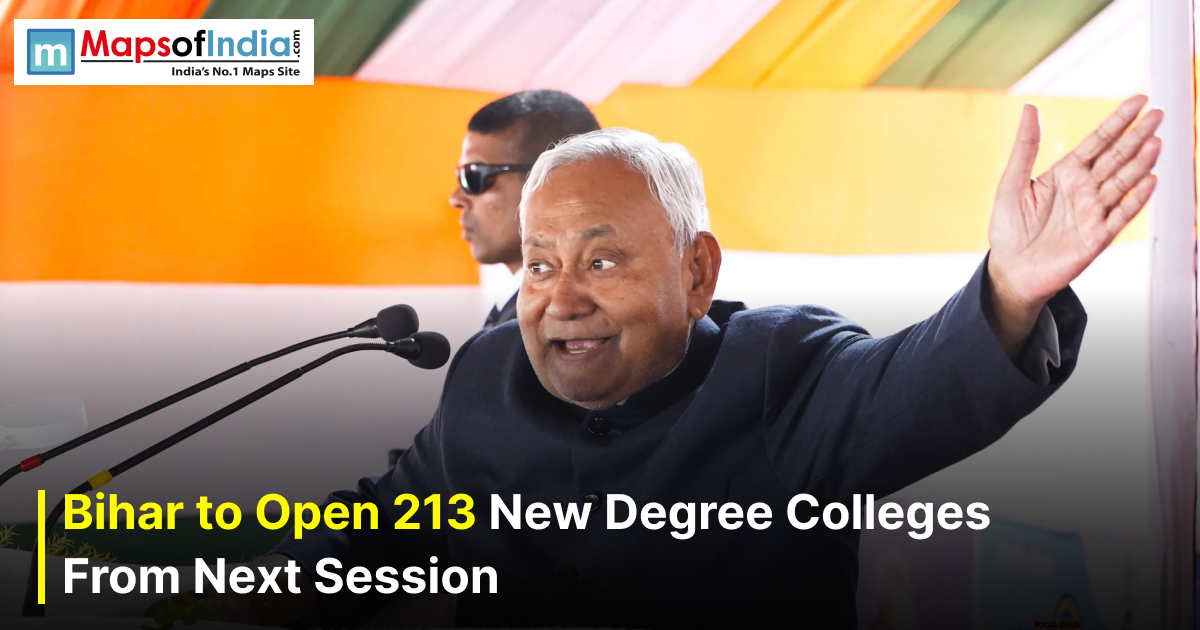
The Bihar government has also made a major announcement regarding higher education by declaring that 213 new degree colleges would be opened throughout the state, and the academic proceedings would start in the next academic year. The move is set to make sure that the undergraduate education is offered in the blocks that do not have any level of program or degree, and this will greatly eliminate the long distance that students have to cover waiting to get a higher qualification.
Chief Minister Nitish Kumar mentioned that the initiative is under the state Saat Nischay-3 programme, which aims at enhancing education and enhancing employment opportunities for young people. The officials said that of the total blocks in Bihar, 213 are yet to have degree colleges, and these new colleges will be established in those regions that are underserved. The relocation will have a positive impact on thousands of students, particularly the rural-based students.
The officials of the education department reported that the absence of close colleges is one of the major contributors to poor enrolment and increased dropout rates among female students. Through the provision of higher education at the block level, the government hopes to enhance inclusivity, better enrolment rates, and facilitate the existence of a more balanced education system in the state.
In addition to new colleges being opened, the state government has also declared intentions to transform 55 already existing learning institutions into Centres of Excellence. Such institutes will receive modernization in terms of infrastructure, better facilities and enhanced curricula to provide quality education with employment orientation. It is aimed at improving the academic standards and making the institutions of Bihar compete nationally.
According to the officials, the Centres of Excellence are to be worked out after consultation with the seasoned teachers, academic experts, and students. Some of the upgrades suggested are smart classrooms, digital libraries, state-of-the-art labs, research facilities and skill development centres. The extra attention will be given to science, technology, innovation, and vocational education to improve the employability of students.
The education department has been advised to fast-track the administrative approvals, development of infrastructure and faculty recruitment in such a way that teaching can commence without delays. Where permanent buildings cannot be ready at once, temporary arrangements will be made to ensure classes commence on time.
The education experts have embraced the news as a major milestone towards eliminating the differences in higher education in the region. Nevertheless, they have also highlighted the importance of appointing qualified faculty on time and providing long-term funding to facilitate quality education.
Bihar plans to establish a more accessible, inclusive and quality-focused system of higher education in response to the increasing population of students in the state, with the introduction of 213 new degree colleges and conversion of 55 institutions into Centres of Excellence.