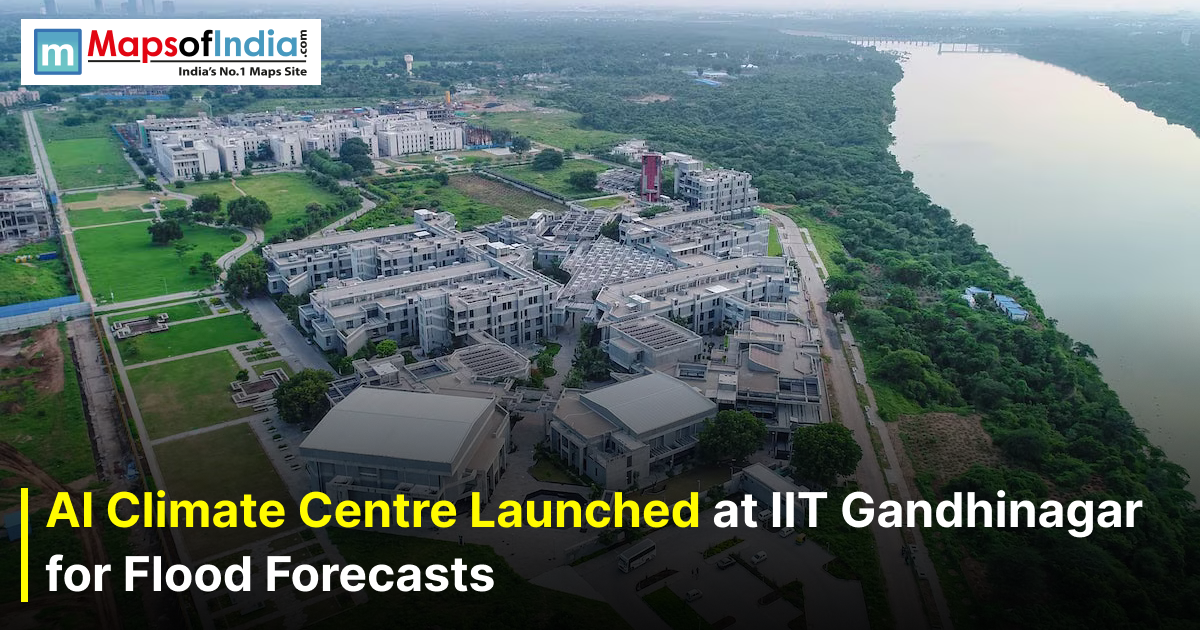
Indian Institute of Technology, Gandhinagar (IIT-Gn) has, in a significant technological breakthrough, established an AI-driven Climate and Flood Forecasting Centre which can assist authorities in predicting the location and severity of flooding, based on predictions of rainfall. The effort is to enhance disaster preparedness and minimize the destruction triggered by extreme weather events.
The new centre, which is called the AI Resilience and Command (ARC) Centre, will apply artificial intelligence, real-time weather information, and enhanced climate models to turn the forecasts of rainfall into flood risk operational forecasts. This AI-based platform will predict the extent of floods, the depth, and the area covered prior to the occurrence of heavy rainfall, unlike conventional weather forecasting systems, which only give a probability of rain.
The officials of the IIT Gandhinagar claim that the centre combines the rainfall forecasts, topography, drainage systems, land-use schemes, and past flood experiences to model the flood situations with great precision. These AIs are aimed at determining the extent of water that can be stored, the locations that are at risk, and the speed at which flooding can occur following heavy precipitation.
The centre will be instrumental in facilitating the state governments, the local bodies of the urban areas, and the disaster-management agencies. By delivering early and accurate warnings on floods, the authorities are capable of scheduling evacuations, mobilizing emergency services, managing the reservoirs, and saving key infrastructure beforehand.
There has been a tendency for heavy downfalls and flash floods in India over the last couple of years, particularly in the cities as well as the lowlands. There is a belief that climate change has created unpredictable weather, and this has resulted in using conventional forms of forecasting to provide a reasonable response to calamities. The AI Climate Centre intends to solve this gap by providing location-specific and impact-based predictions, instead of general weather warnings.
According to researchers at IIT Gandhinagar, the project is an AI-based analytics mixed with climate modelling based on physics, which makes predictions both scientifically sound and data-intensive. Another area that the centre will be involved in is the long-term climate risk assessment that will aid policymakers in developing climate-resilient infrastructure and urban development.
The introduction of the AI Climate Centre will be a milestone in disaster risk reduction in India based on technology. It is believed that the centre will save lives, minimize economic losses, and boost the capacity of the country to act proactively to address the challenges that affect the climate by the conversion of rain forecasts into specific flood impact assessment evaluations.
With the rise in the intensity of climate risks, such initiatives emphasize the increasingly important role that artificial intelligence would play in helping communities to be more resilient and safer in the context of natural disasters.