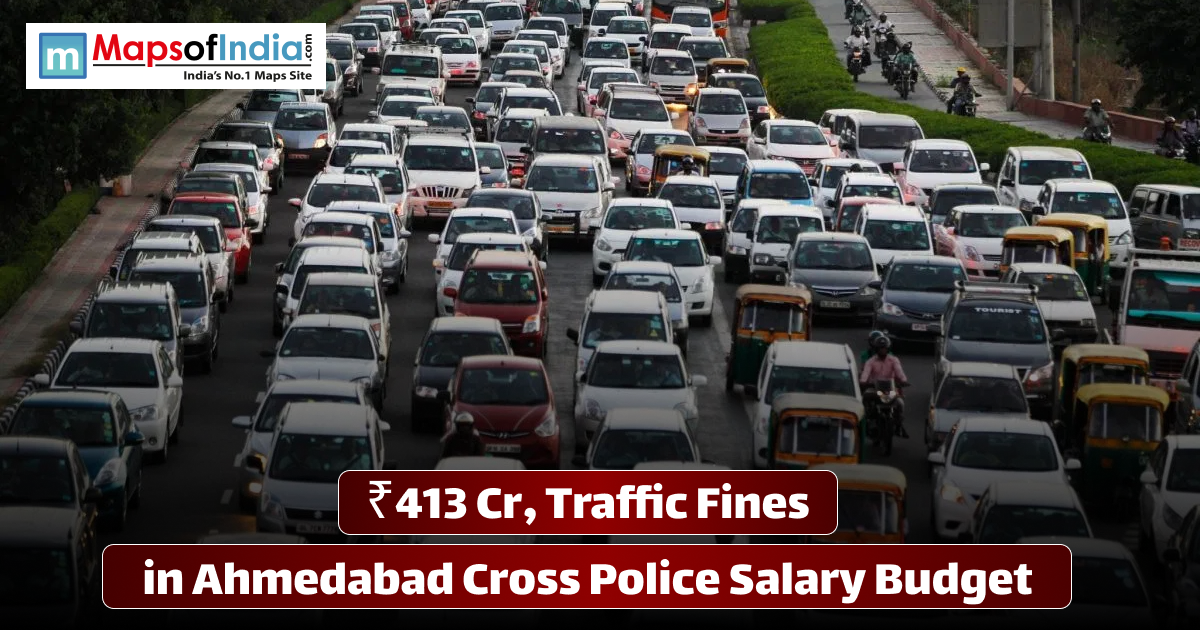
Traffic police in Ahmedabad have generated a whopping ₹413 crore in traffic fines during the past two years, which elicited a lot of debate, as this amount is more than what the traffic police force in Ahmedabad has earned in terms of salary. The information identifies the magnitude of traffic offences in the largest city of Gujarat and the growing dependence on the severity of enforcement measures.
The huge sum has been raised by penalties charged against several violations of traffic laws, which were not wearing a helmet while riding, running traffic lights, speeding, driving on the wrong side and other law breakings. The pushing force has been pursued in recent years by the increased exploitation of e-challans, surveillance cameras, and on-the-spot fines, which have resulted in an amazing increase in the number of cases being booked and the volume raised.
The traffic police recorded more than 21 lakh cases of violation of the traffic laws in 2024, and the amount payable in fines amounted to about ₹151 crore. The trend escalated even more in 2025, and almost 40 lakh cases were registered, leading to a fine collection of approximately ₹262 crore. In a combined effort, these numbers escalated the overall value of the penalty to ₹413 crore in two years only.
Of specific concern has been the comparison of the fine collection budget and the salary budget of the traffic police, which is actually lower than the amount of revenue collected by penalties. Although the fines obtained are put in the government treasury, the traffic police department does not regulate the money directly. Part of this money is supposed to be used in enhancing road safety, traffic management infrastructures, awareness creation, and to purchase equipment, but officials reveal that such funds are usually not released on time.
The progress has elicited both positive and negative responses amongst citizens. Some residents may complain that high enforcement may be the sole remedy to curb careless driving and enhance road safety, but on the other hand, they also believe that traffic policing is gradually being seen as a tool for generating revenue instead of acting as a social protection in the community. Issues of road conditions, signage and infrastructure have also raised concerns, and people have questioned whether the money collected by way of fines is being returned to better traffic systems.
Traffic officials, nevertheless, insist that their primary goal in enforcement is discipline and road accidents, and not to acquire revenue. Ahmedabad is still experiencing a large number of vehicles and common jams, hence adherence to the traffic rules is vital for these people.
The ₹413 crore amount has once again brought up the debate on ways to use the revenue collected by way of traffic fines, disclosure in the use of funds and also the necessity of balanced enforcement as well as improved infrastructure. With the increase in the number of traffic, the problem will probably continue to occupy a central place in the city discourse.