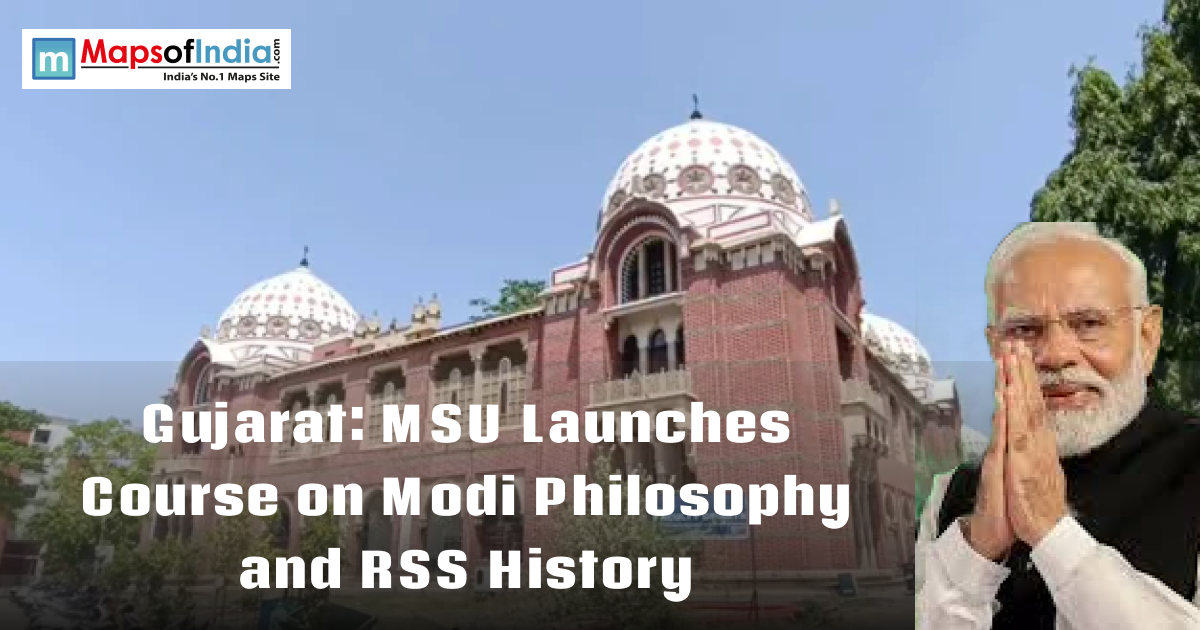
In a move that has caused much debate, Maharaja Sayajirao University of Baroda (MSU) in Vadodara has introduced a new academic element to its sociology curriculum that focuses on the leadership philosophy of Narendra Modi and the historical development of the Rashtriya Swayamsevak Sangh (RSS).
The new modules will be part of both undergraduate and postgraduate sociology courses, according to university officials. The project will equip students with a greater insight into contemporary Indian socio-political relations through studying influential leaders and organizations as a part of academic discourse.
One of the key highlights of the curriculum is a module titled “Modi Tattva,” which examines the leadership style, governance approach, and policy impact of Prime Minister Narendra Modi. The students will examine such major initiatives as Digital India, Swachh Bharat Abhiyan, and Make in India in the framework of a sociological approach and evaluate their impact on Indian society and development.
Besides this, the course will include the history, structure and functioning of the Rashtriya Swayamsevak Sangh. The students will delve into the origin of the organization, its ideological structure and its contribution to the formation of cultural and social discourses in India. Case studies and learning in the field may also be included in the syllabus to provide a practical understanding of how such organizations work.
According to the university authorities, the aim of introducing these subjects is to fill the gap between the theoretical knowledge and the developments that are going on in the real world. A faculty member explained that sociology is about the understanding of society in its current form. It involves the critical analysis by the students of the current changes within society.
Nonetheless, the relocation has raised both negative and positive sentiments in different quarters. Proponents claim that the inclusion of Indian points of view and present-day leadership into academia is a forward move that increases relevancy and interest. Critics have, however, raised the concern of the possibility of ideological bias and the necessity to bring about academic neutrality and balanced representation in university curricula.
In spite of the controversy, MSU has maintained that the course is designed to be analyzed purely academically and that the course is designed to promote critical thinking rather than an ideology. The university has also indicated that different viewpoints will be factored in, such that there will be a comprehensive view of the topic.
The introduction of this course could be regarded as a subset of an even broader pattern in the world of higher education, where students are becoming increasingly engaged in the process of introducing modern socio-political issues into the academic program. With the ongoing debate, the project will continue to be a point of interest as an illustration of changing educational priorities in India.