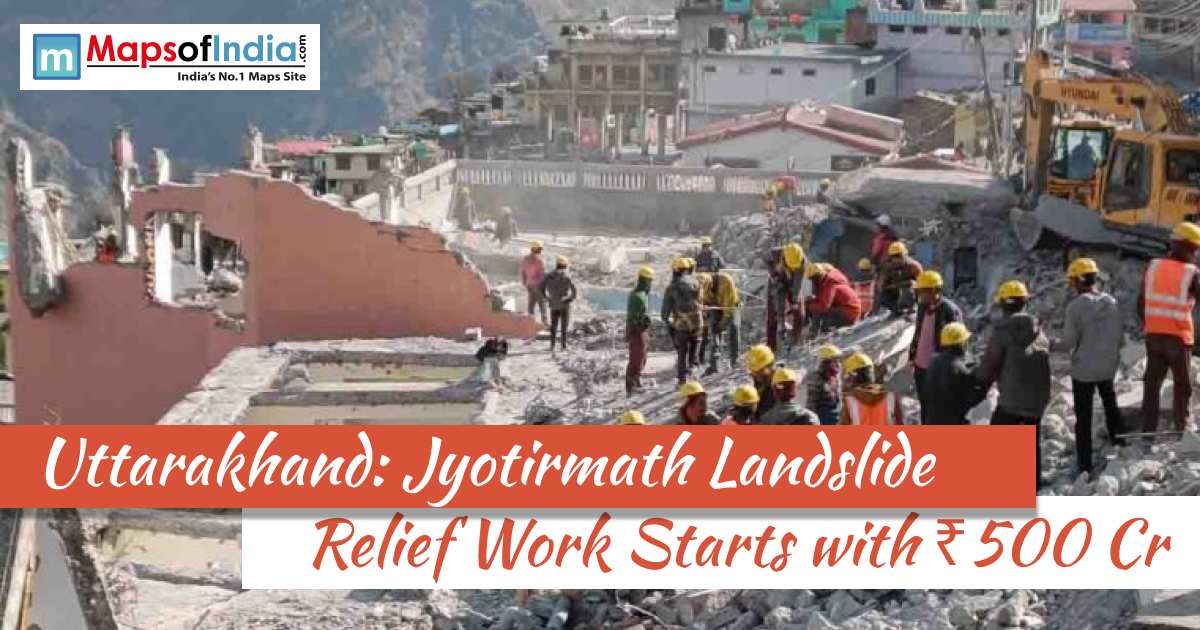
The government has started work on the treatment and rehabilitation of the landslide-affected town of Jyotirmath with an investment of 500 crores as a major step towards stabilizing the town. The relocation will come as a huge relief to the people who have been grappling with subsistence of the land and structural damage in the past several years.
The geological instability experienced in Jyotirmath in the Chamoli district of Uttarakhand has been severe since early 2023, when cracks have started appearing on houses, roads, and the public infrastructure. The crisis caused the evacuation of a number of families, the destruction of hazardous buildings, and general panic among the locals. The cause of the subsidence was blamed on weak Himalayan geology, unplanned construction, drainage reasons and natural causes as indicated by experts.
With permission of 500 crore, authorities have now started extensive treatment, including treatment of vulnerable slopes to stabilize them and prevent further movement of the ground. The project incorporates slope strength, improved drainage systems, construction of retaining walls, management, and strengthening of damaged infrastructures. Geologists and engineers have been sent to make an evaluation of the risky areas and apply scientific measures.
The officials have said that the investment is a move towards long-term disaster response and mitigation. This was not relief work, but a systematic rehabilitation strategy which would ensure the future of the Jyotirmath, said a senior state government official. The program also involves compensation, relocation and housing reimbursement to the families whose houses have been declared unsafe.
Jyotirmath is an important port of entry to the Char Dham pilgrimage circuit, which includes Badrinath, and is important to the economy of the region. Besides the daily life, which was disrupted, tourism and local business were also affected by the landslide crisis. The inhabitants have been pressuring the government to do something fast so that people can feel safe and rebuild their confidence.
The 500 crore budget is an extension of a higher recovery plan that had been adopted previously to solve the long term environmental and structural problems of the town. The authorities underscored the fact that scientific surveillance systems will be put in place as well in order to monitor land movement and thwart future disasters.
To the concerned families, the initiation of treatment work is a new hope. As long as the challenges exist, the financial commitment of the government shows serious intentions to restore the historic Himalayan town and preserve it against further losses.
The next few months will be pivotal as the stabilization process continues, and people will be keen on observing real changes in their safety and infrastructure.