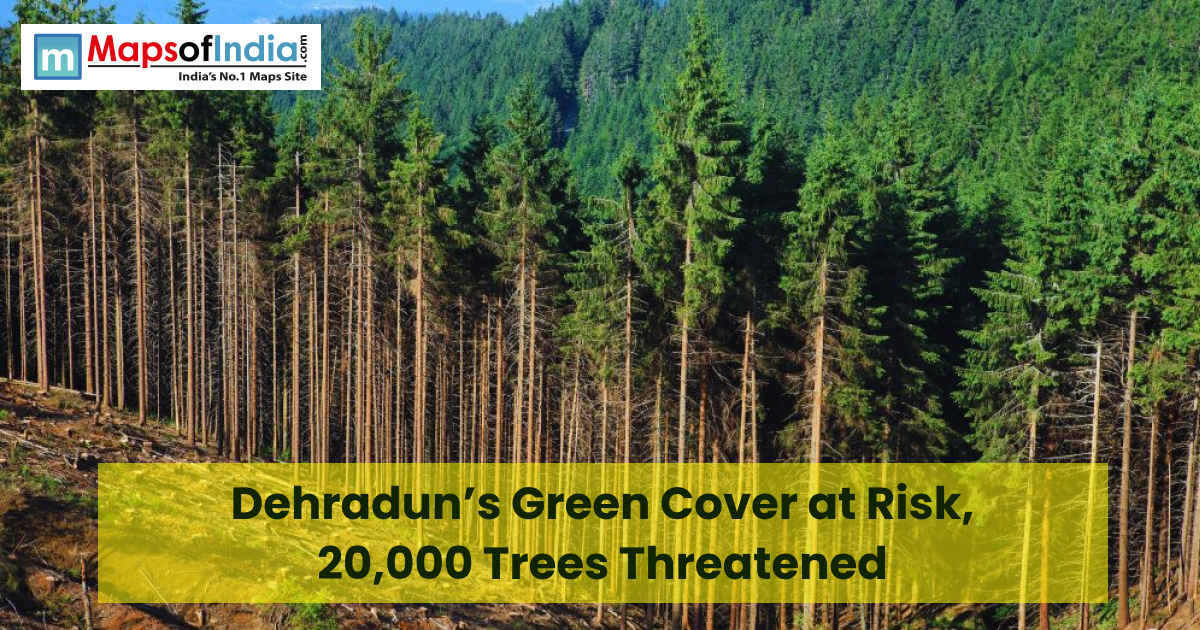
Once having an extraordinarily beautiful landscape and marked by its forests, Dehradun is currently experiencing an increasing environmental challenge as almost 20,000 trees are said to be at risk of damage because of a high pest infestation. The authorities of the forest and environmentists have also expressed concerns that a substantial area of the green belt surrounding the city would be seriously damaged unless action is taken.
Aggressive insect attack, according to the officials in the forest department, is the main reason behind the problem that has afflicted Sal and other native tree species in several forest divisions, including those bordering Mussoorie and Kalsi. The insects drilled into the trunks, undermined the trees internally and rendered them structurally unsound. In extreme incidences, the diseased trees are prone to falling, particularly during strong winds or heavy rainfalls, and this may be a hazard to the local people and forest workers.
In the initial test, it can be said that there are thousands of trees that bear visible infestation as seen in hollowed trunks, dry branches and lower foliage. The governments have said that in case the damage survives, there might be a need to clear large areas of the infected trees to avoid additional ecological and safety risks.
Environmental agencies have also raised environmental concerns with regard to the possible effect of the growing green cover in Dehradun, which is already on a downward spiral. The urban growth in the city has been very fast in recent years, and activists believe that the destruction of so many trees can lead to poor air conditions, warmer temperatures, and the destruction of the biodiversity of the area. This may also affect birds, insects and small mammals that use these patches of forests as their habitat.
Forest authorities have started keeping a close check on the situation and are looking into the possibility of implementing some form of control to allow the infestation to be contained. These involve the use of identification of affected areas, removal of trees that are highly affected in stages and the use of pest control methods to secure the less damaged parts of the forest. Specialists have also suggested that more awareness creation should be done in local communities so that they can report on cases of infestation in the early stages.
The local people have had both positive and negative feelings regarding the safety and the fear of losing the natural heritage of the city. It has been requested by many that the importance of environmentally-friendly solutions and replanting initiatives should be at the top of the authorities’ agenda to make up for the required amount of trees that are supposed to be cut.
Even as Dehradun struggles to cope with this environmental dilemma, the next few weeks will be very crucial in understanding whether it is possible to contain the infestation without having to lose much of the green cover. The case underscores the greater need to carry out forest management and conservation of forests in the long term to maintain the ecological balance in the city, as environmental pressures on the city continue to mount.